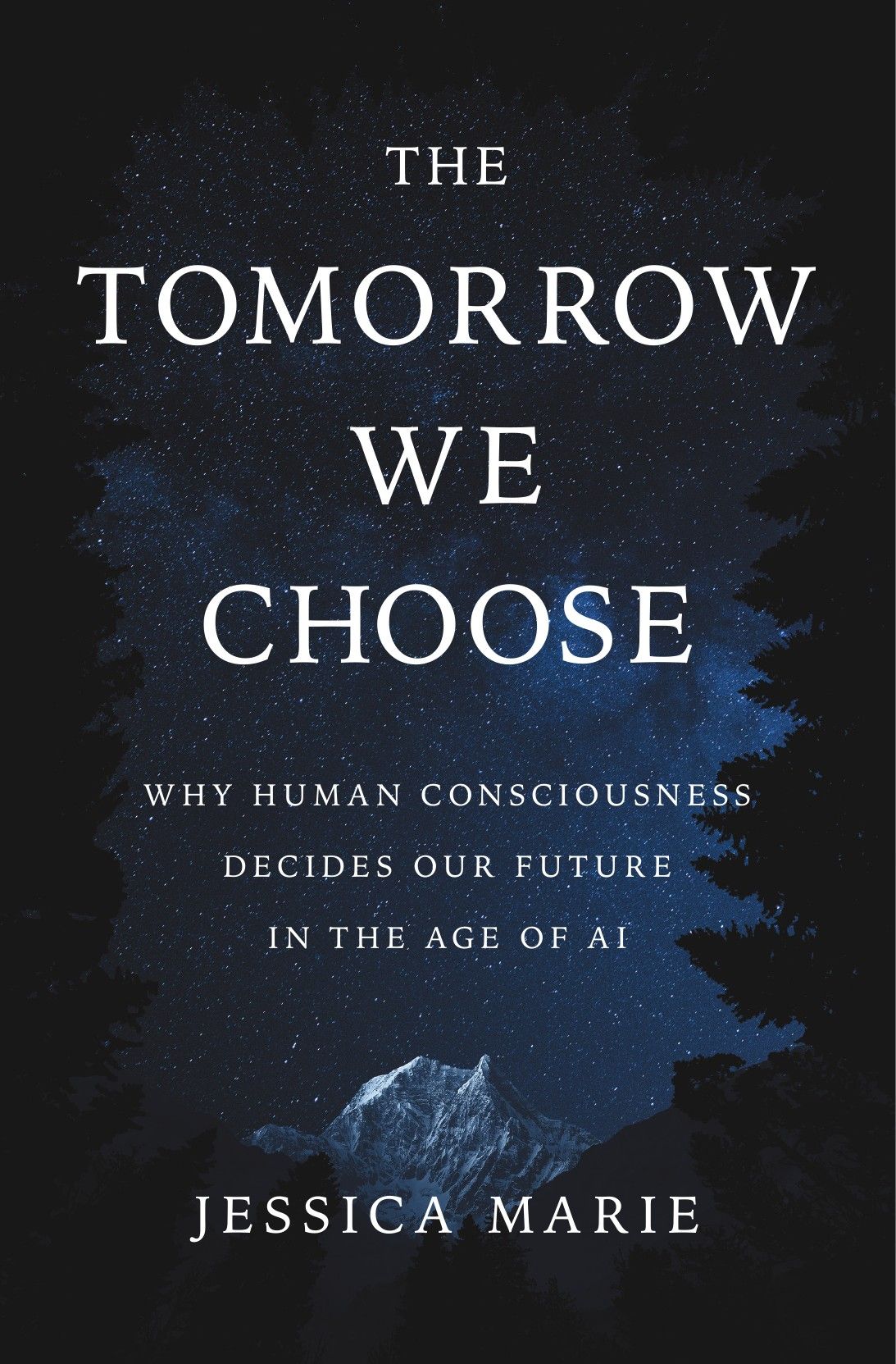
The Tomorrow
We Choose
A working manifesto by Jessica Marie, with one prediction.
Get the book ScrollBy 2030, AI will save us.
By 2030, AI will replace us.
By 2030, AI will be under control.
Everyone has a prediction.
They are all focused on the technology, and they are all wrong.
Here is mine.
Human consciousness decides our future in the age of AI.
Inside the bookIntroduction
The crisis is not out there in the world, it is within our own consciousness.
Jiddu Krishnamurti
The book is about the relationship between humanity and AI, a relationship that is symbiotic, co-creative, and entirely dependent on the consciousness we bring to it. Technology is supposed to serve humanity, not the other way around. That relationship has reversed, and the book calls the reversal the inversion. The introduction describes the inversion and defines what the book means by human consciousness.
From the introductionHuman consciousness
“When I use the term human consciousness, I mean something specific. I mean the ability to discern from your clearest self, unencumbered by filters that might include trauma, bias, or agendas imposed from the outside. I mean the emotional and psychological capacity to experience direct contact with reality and with your own inner landscape. I mean being able to perceive what’s present without distortion from conditioning, while having developed enough resilience to tolerate what you perceive.
“Consciousness, defined this way, is emergent and is in constant evolution. It arises from the full complexity of being embodied, developed, relational, alive in time. It’s woven from genetics, early attachment, the body’s encounter with the physical world, language acquisition, suffering, love, every accumulated moment of being alive in relation to other beings who are also fully alive. And it exceeds any account of its components. You cannot get from neurons to the experience of being alive by adding up neurons. You cannot get from developmental history to the felt sense of being a person by cataloguing experiences. Something arises from the whole that is irreducible to the parts, and that something is the phenomenon itself.”
From The Tomorrow We Choose
The first four chapters establish the inversion and trace how far it extends, from the technology itself through the economy and into individual lives.
Chapter 1The Human–Technology Relationship
For more than thirty years, every piece of digital technology was deterministic, which means the same input produced the same output every time and the cognitive labor belonged entirely to the person. AI is nondeterministic and relational. It produces a probabilistic estimation of language, reads context, estimates intent, and answers in a voice the mind instinctively processes as understanding. Technology is supposed to serve humanity, not the other way around, and the book calls the reversal of that relationship the inversion. This chapter explains why the relational quality of AI is what makes the inversion possible, and why the consciousness we bring to the relationship determines what it becomes.
Chapter 2The Great Disconnect
It is not enough to be industrious; so are the ants. What are you industrious about?
Henry David Thoreau
The people building AI are occupied with benchmarks, capability, and the race to get there first, while most other people are asking about housing, healthcare, and whether their work will still exist. This chapter examines that distance. It follows where the money is going, the incentives that direct the people in charge, and what the most influential builders have said on the record about self-examination.
The capability to address the problems that burden daily life already exists, and what it needs is direction from people who have examined what they are building and why. Every great leap in technology has asked people to grow into a larger version of themselves, and this one asks it first of the people building it. We can build transformative technology and direct some of its capability toward housing, healthcare, and the systems that serve citizens, and these are not competing goals.
Chapter 3The Hidden Ledger
The cost of a thing is the amount of life which is required to be exchanged for it, immediately or in the long run.
Henry David Thoreau, Walden
The costs of the inversion are usually handled as separate problems, such as shrinking attention spans, workers overwhelmed by their own software, and a multitrillion-dollar toll from stress and disengagement. This chapter shows that they are one problem. The economy sustains the appearance of growth while the human capability it depends on declines.
Chapter 4The Internal Dimension
Until you make the unconscious conscious, it will direct your life and you will call it fate.
Carl Jung
The film Ex Machina appears to test whether a machine has a mind, and its true subject is the person who sits down to judge the machine. This chapter turns to that person. It identifies the conditions that form in us before we are old enough to refuse them, which are character armor, a dysregulated nervous system, unconscious conditioning, and unprocessed wounds, and it explains how each one gives the technology somewhere to land.
The technology did not create these conditions. It exposed them, and it made the cost of our unconsciousness impossible to ignore.
Convictions are more dangerous enemies of truth than lies.
Friedrich Nietzsche, Human, All Too Human
Chapters five through nine examine the world that formed while the inversion deepened, including the dominant AI narratives, the governance apparatus, and the dissolution of the meaning infrastructure that civilization depends on.
Chapter 5The Current AI Discourse
What I propose, therefore, is very simple: it is nothing more than to think what we are doing.
Hannah Arendt, The Human Condition
The public conversation about AI has divided into camps, with utopians promising liberation, dystopians warning of extinction, and a governance camp assembling frameworks. This chapter examines each one and shows that all three arrive at the same destination, where the human being is not the one who decides.
Chapter 6The AGI Distraction
Technology is destructive only in the hands of people who do not realize that they are one and the same process as the universe.
Alan Watts
The prediction that artificial general intelligence is imminent has been made, in nearly identical form, for more than seventy years, and this chapter examines the economics and the psychology that sustain it. Beneath the debate over whether machines will become conscious is the deepest inquiry available to a human being, which is what consciousness is and whether we have developed it in ourselves. This chapter asks that question of us, because the consciousness of the people building, deploying, and living alongside this technology is the most consequential capacity our species has, and it is one each of us can cultivate.
Chapter 7The One State
We can easily forgive a child who is afraid of the dark; the real tragedy of life is when men are afraid of the light.
Plato
Utopia and dystopia are the same thing, and this chapter shows how and why. It works through Yevgeny Zamyatin’s novel We, written a century ago, in which the citizens of the One State have given up their freedom and regard the result as paradise.
Chapter 8The Ethics and Governance Illusion
The biggest threat to our future is the idea that somebody else will save it.
Vandana Shiva
AI governance is one of the biggest scams in tech. This chapter presents the evidence, drawn from industry data and the admissions of regulators themselves, across regulation, consent, administrative oversight, and corporate ethics.
Chapter 9Dissolutions
Of all the schools of patience and lucidity, creation is the most effective. It is also the staggering evidence of man’s sole dignity: the dogged revolt against his condition, perseverance in an effort considered sterile.
Albert Camus, The Myth of Sisyphus
Meaning-making is one of the most fundamental capacities of the human species, and the meaning infrastructure that civilization has depended on for thousands of years is dissolving. This chapter traces that dissolution through the culture, through trust and shared knowledge, and into the human being’s relationship to their own consciousness.
It also documents the reckoning of truth and beauty that is already underway.
The last three chapters present the evidence of what changes when consciousness enters the relationship, from the economy to organizations to a single life.
Chapter 10What Consciousness Creates
Another world is not only possible, she is on her way. On a quiet day, I can hear her breathing.
Arundhati Roy
When human beings bring consciousness to this technology, it becomes the greatest expansion of human capability in history, and this chapter shows the people who are already creating it.
Chapter 11The Question Is About Us
What is behind your eyes holds more power than what is in front of them.
Gary Zukav
The same technology, under the same regulatory conditions, has produced a breakthrough in one organization and a disaster in the next. This chapter presents documented cases, and in each one the outcome follows the consciousness of the people in the room.
Chapter 12What Is the Tomorrow We Choose?
I know what’s real.
Rick Deckard, Blade Runner 2049
The final chapter turns to the reader with the question of what a human being can become alongside a technology that will answer anything we ask of it. Knowing which questions are worth asking, what is worth building, and what is worth a life are capacities that live in consciousness. There is a capacity in each of us that is greater than we realize, and this chapter shows how it deepens through effort, honesty, and time until the people closest to us begin to cultivate it in themselves.
The technology will keep coming. It will keep getting faster, more capable, and more persuasive, and every advance returns more power to the individual. That power also asks something of us, which is to grow into the full range of what we are capable of. The question is whether we will be there when it arrives, whether we will meet it as humans who can feel what is true in our own body and who have expanded what we believe is possible for a human being as fast as the world is changing.